
We embedded Spontivly inside a $100B+ RIA platform. Here's what it taught us.
Spontivly is now a growth data platform for RIAs. Five lessons from embedding inside a $100B+ RIA service provider, and what they mean for your firm.

Spontivly is now a growth data platform for RIAs.
For years we ran growth and marketing analytics for agencies and community-driven organizations. Then we embedded inside a $100B+ RIA service provider to stress test the product, and found a data problem far bigger than marketing.
We started by running growth for agencies and community-driven organizations.
As many know, Spontivly started as a marketing and growth analytics platform. Our customers were agencies, community-driven organizations, and companies that had outgrown their spreadsheets and needed their marketing data to connect to whatever happened after the lead.
Investors like Mark Cuban and Ryan Holmes backed the team early on a straightforward bet: that non-technical teams shouldn't need an engineering department to get answers out of their own data. That was the mission then, it still is to this day.
None of that sounds like wealth management, and it wasn't at the time. But the underlying job never changed - take a handful of systems that each hold part of the truth, and get them to agree on one version of it. That skill turned out to travel a lot further than we expected, we just hadn't met the industry that needed it most.
Then we embedded inside a $100B+ RIA platform.
The plan was simple, put the product inside a large, sophisticated RIA service provider, watch what breaks under real conditions, ship the fixes, get back to the roadmap.
We were there to answer marketing questions. Where advisors come from, which channels produce relationships that last, what growth actually costs, etc…
What took longer was painting a picture of growth across the entire firm. Marketing was one input. The rest lived in systems that had never been introduced to each other. The custodian held the balances, the PMS performance, the CRM the relationship, billing the revenue.
At $100B, you solve that with headcount. At $300M, you solve it at night, in a spreadsheet, on one person's desktop. That's who we build for now.
The problem was never just marketing data.
Marketing was one input. The rest of the firm's picture lived across systems that had never been introduced to each other.
The system | What it owns | Where it stops |
|---|---|---|
Custodian | Positions, balances, transactions | No view of the relationship behind the account, or the fee that follows it |
Portfolio management system | Performance and client reporting | Households rebuilt by hand, mappings that drift when someone leaves |
CRM | Relationships, notes, activity | AUM that never matches the PMS, so nobody trusts the field |
Billing | Revenue | Fee schedules in a spreadsheet with one owner and no backup |
Marketing | Traffic, campaigns, leads | Attribution that dies the moment a lead becomes an account |
Ask a simple question that crosses two of those rows and the answer takes days. What does this relationship earn net of the cost to serve it. Which channels produce clients who stay. Which advisors carry which economics.
At a firm operating at that scale, this is solvable. You assign people to it, you absorb the cost because you have the cost to absorb.
That's exactly what told us where the real problem was.
Smaller firms have the same problem and none of the options.
A firm running $300M has the same fragmented stack as a firm running $100B. Same custodial feeds, same CRM drift, same reconciliation work. What it doesn't have is a data team, an internal tools budget, or the leverage to make four vendors integrate on its behalf.
So the work still happens. It just happens manually, at night, in a spreadsheet on one person's desktop, and it doesn't scale past the person doing it.
That's the gap we're building for. Firms between $100M and $1B+ in AUM, running real complexity without the infrastructure the top of the market takes for granted.
"Every system in your stack tells you what you manage. None of them tell you how you grew.
Spontivly connects your custodian, PMS, CRM, and billing into one source of truth, then ties it back to the referrals, events, and relationships that actually built your book. You don't replace anything. You don't learn a new interface.
Right now, how you grew lives in three spreadsheets and one person's memory. That works until that person leaves, or until you try to sell the firm."
Anthony Nagendraraj, Co-founder and CEO, Spontivly
Here's what that year actually taught us.
Five things changed how we build.
The data problem was never just a technology problem.
The tools to centralize your data have existed for years, so the holdup was never technology. Centralizing only works when everyone commits to one source of truth.
Solutions should be built for the practice, not the portfolio.
Most RIA software treats your client as an account with a balance. But a firm isn't a pile of accounts, it's a living practice of prospects, advisors, clients, and the signals moving between them.
Community scales slow, and that's exactly why it's worth it.
We both came from community work before we started building software, so we learned early that trust compounds on its own schedule. You can automate a report. You can't automate the ten years it took to earn a referral. The best software protects that work instead of trying to speed it up.
The compliance problem is a data problem wearing a different hat.
Once you can see the whole firm in one place, disclosure stops being a filing exercise and becomes something you can trigger automatically, at the moment it's actually required. We filed a provisional patent on that approach, covering how the right disclosure reaches the right audience based on who they are and what they're about to see. It came directly out of what we watched firms do by hand.
Growth should never cost you the relationship.
Growing your practice should never mean your clients hear from you less. The relationship is the practice. We hold Spontivly to that same standard.
We built the advisory board before we built the roadmap.
Building for a regulated industry means you don't get to guess, and it means outside opinions have to arrive early enough to change something.
So we stood up a Product Advisory Board of operators who live inside these firms. They see roadmap before it ships and they tell us when something won't survive contact with a real practice.
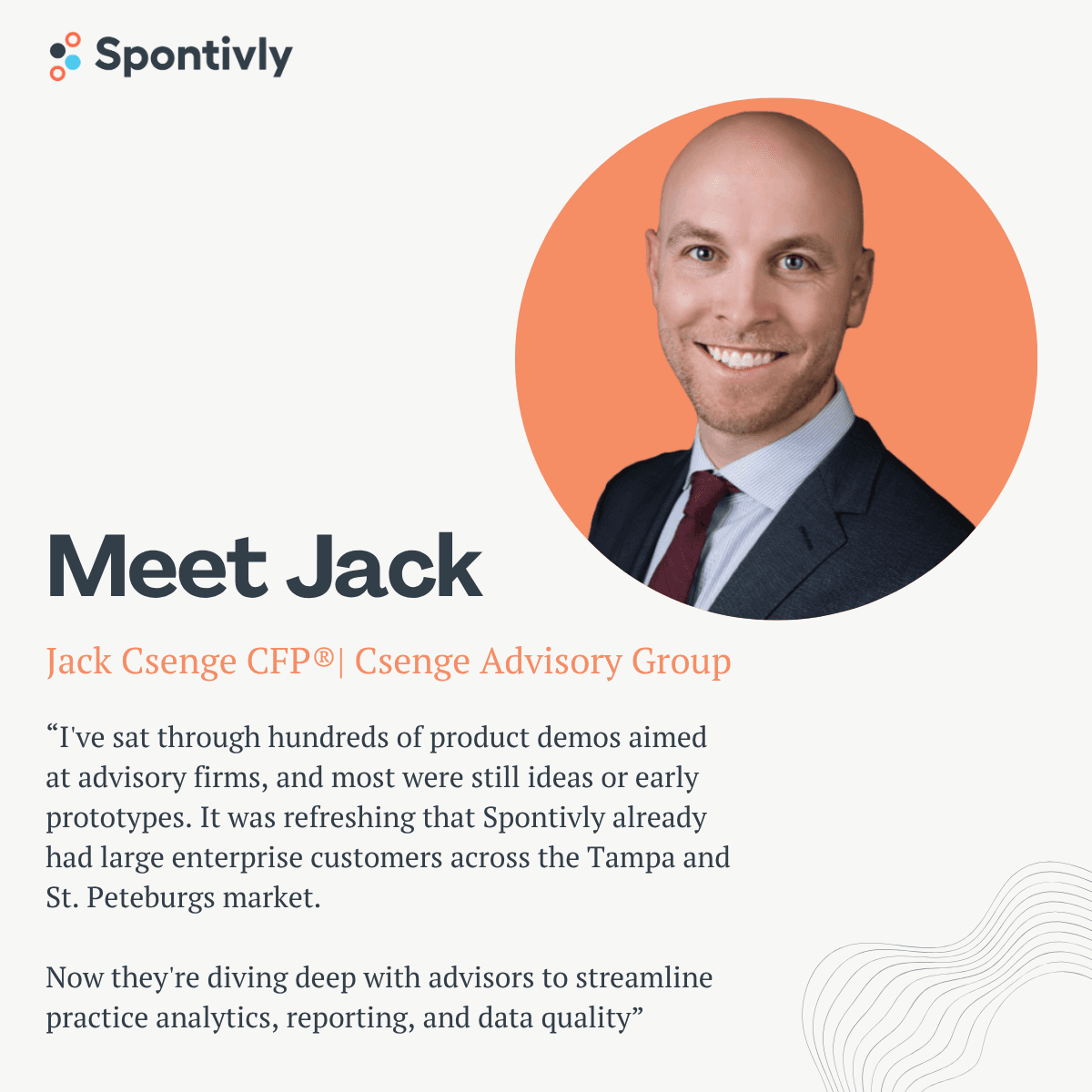
Jack Csenge, CFP® joins as a founding member. Jack is a Wealth Advisor at Csenge Advisory Group, a Clearwater RIA now nearing its 30th year in business, and he works with advisors across the country on practice management, planning cases, and operational efficiency. He's also built a company himself, so he arrives at product conversations already thinking in workflows.
Here's what this means for your firm.
The test takes thirty seconds. Ask your team how long it takes to answer, with confidence, what a single client relationship earns you net of the cost to serve it.
If the answer involves a spreadsheet and a person, we should talk.
We're taking a small number of design partners while our roadmap is still soft enough to bend.
A pilot means you test finished software, a design partner tells us what to build. You bring the specific version of the problem your firm actually has, and we build against it while the roadmap is still soft enough to bend.
Your workflow becomes the default, not a configuration option you fight with later. We start where every firm starts, which is data quality. Households that don't match across systems. Fee schedules living somewhere nobody wants to admit. Mappings that drifted three years ago and never got reconciled. You get that cleaned up as part of the engagement, which is worth something on its own.
What you get back is a system shaped around how your firm actually works, at a level of access that won't exist once this is generally available.
Design partner conversations are happening now, and the advisory board is still growing.