
The Miro Acquisition, Explained: The Other Side of the AI Wealth Boom Variant
Five weeks after we mapped this playbook on the Airtable deal, Bending Spoons bought Miro. The pattern points at the half of the AI wealth story nobody is pricing: what it's destroying, not what it's creating.
The Miro Acquisition, Explained: The Other Side of the AI Wealth Boom
Published September 11, 2026
Bending Spoons agreed to buy Miro for $1.355 billion, roughly $1.79 billion counting the cash on its balance sheet. Miro was worth $17.5 billion in 2022. Everyone is watching AI create trillion-dollar winners like Anthropic and OpenAI. Almost nobody is pricing the other side of that story: the same wave is quietly gutting the last generation of software, and Miro is the clearest casualty yet.
Here is why this deal belongs on your radar, even if your firm has never opened a Miro board. Five weeks ago, when Bending Spoons bought Airtable, we laid out exactly how this company operates and predicted it was only getting started. We called Airtable its first acquisition as a public company. Miro is the second, and it lands only five weeks later. Two category-leading software companies, repriced by roughly 90% from their peaks and sold for parts, inside five weeks. That is not a run of bad luck at two companies. It is a pattern, and the pattern is the story your clients need you to explain.
Let's break it down.
What actually happened in the Miro acquisition?
Bending Spoons, the Milan-based software holding company that IPO'd on the Nasdaq in July 2026, agreed to buy Miro in an all-cash deal. Miro is the digital whiteboard and visual collaboration platform that design, product, and engineering teams use to plan work together. It became one of the default tools of remote work.
The deal | Figure |
|---|---|
Buyer | Bending Spoons (Milan, IPO'd July 2026) |
Enterprise value | ~$1.355 billion, all cash |
Equity value (incl. net cash) | ~$1.79 billion |
Miro ARR (2026) | ~$600 million, ~90% from business and enterprise |
Revenue multiple | ~2.3x ARR |
Scale | 250,000+ organizations, ~4 million paying users, 750+ customers over $100K ARR |
Notable term | ~$295 million of proceeds rolled by certain Miro shareholders into new Bending Spoons stock |
Expected close | Q4 2026 |
Note the scale line. This is a real business with a quarter-million paying organizations and $600 million in recurring revenue. It is not a flameout. Which makes the next question the important one.
Why couldn't a $600 million company stay independent?
Because Miro is a zombie unicorn, and it is not the only one.
A whole class of companies raised enormous rounds at peak-boom valuations in 2021 and 2022. They are now too big to be quietly acqui-hired, too slow-growing to go public anywhere near their private marks, and long past the era of cheap venture money that funded them. They are alive. They generate real revenue. And they have no path back to the valuation printed on their employees' equity statements. That is a zombie unicorn: a healthy-looking company with a dead valuation.
Miro is the textbook case.
Miro milestone | Detail |
|---|---|
Founded | ~2011 (originally RealtimeBoard) |
Total raised | ~$476 million |
Peak valuation | $17.5 billion (January 2022 Series C, led by ICONIQ) |
Revenue multiple at peak | ~41.7x |
ARR trajectory | $420M (2022), $630M (2023), $665M (2024, +5.6% YoY) |
November 2024 | Laid off 18% of its workforce |
2026 sale (enterprise value) | ~$1.355 billion, ~2.3x ARR |
Look at the growth line, because it is the whole story. Miro went from adding revenue in the triple digits to growing 5.6% a year. A company priced at 41.7 times revenue needs to grow into that number for years. Miro's growth fell off a cliff instead. When that happens, the peak valuation does not gently correct. It collapses, and the only exit left is a sale for a fraction of the mark. The question is what knocked the growth over in the first place. The answer is the part almost no one is saying out loud.
What is the other side of the AI wealth boom?
AI is not only creating value. It is destroying it, in the same motion, and the destruction is landing on the generation of software your clients already own.
The headlines all point one direction. Anthropic and OpenAI are minting the largest private fortunes in history, and advisors are rightly focused on helping clients navigate that upside. But look at what happened to Miro's growth exactly as AI-native tools arrived. A whiteboard is a place to organize ideas. AI assistants now do a growing share of that work inside the tools people already use, and a wave of AI-first competitors rebuilt Miro's core features from scratch. Miro's growth stalled to 5.6% right in that window. That is not a coincidence. That is the leading edge of AI eating the previous generation of software.
Here is the counterintuitive part your clients will not get from the headlines. The same force driving the AI equity boom is the force repricing Miro to a tenth of its peak. AI is a two-sided wealth event. It creates enormous value at the frontier and destroys value in the vast middle of incumbent software at the same time. Most people are only watching one side of the ledger.
For an advisor, that reframes the entire client conversation. The interesting question is no longer just "how do I get my client exposure to the AI winners?" It is "how much of my client's existing tech wealth is sitting in companies AI is quietly turning into zombies?" A client can be long the AI boom and short the AI boom at once, and not know it, because both bets live under the same word.
How does the value actually get harvested?
Through a debt-funded roll-up, which is the real mechanism behind both the Airtable and Miro deals.
Bending Spoons runs a private-equity-style playbook applied to software. It buys established brands trading below their peaks, cuts costs hard, optimizes pricing, and runs the businesses for cash rather than growth. It does not flip them. It owns them.
The Bending Spoons machine | Detail |
|---|---|
Model | Buy a known brand below its mark, cut costs, optimize pricing, run for cash, reinvest |
Portfolio | AOL, Evernote, Vimeo, WeTransfer, Brightcove, Meetup, Airtable, now Miro |
Acquisitions to date | 50+, with zero divestitures (built to own permanently) |
Cost playbook | Cut Evernote from 341 employees to 60 (an 82% reduction) |
FY2025 revenue | ~$1.31 billion, up 95% year over year |
Stated ambition | A claimed 1,000+ acquisition targets, each with $50M to $500M in revenue |
This is what the modern exit looks like for a zombie unicorn. Not a triumphant IPO. A quiet, all-cash sale to an acquirer that will strip the cost base and run the product for margin. The value the company created does not vanish. It gets transferred, at a discount, to whoever is disciplined enough to buy at the bottom and patient enough to hold. For a decade the assumption was that a good software company IPOs. The Airtable and Miro deals say the new default for the 2021 class is a roll-up.
Is the roll-up story actually as good as it looks?
No, and an evenhanded advisor should say so. People are starting to notice the gap between the celebratory deal headline and what the deal actually means for the people who built the company. As beehiiv founder Tyler Denk put it, next to the happy acquisition announcement: "miro raised at a $17.5B valuation in 2022 and anyone hired around that mark won't see a dollar."
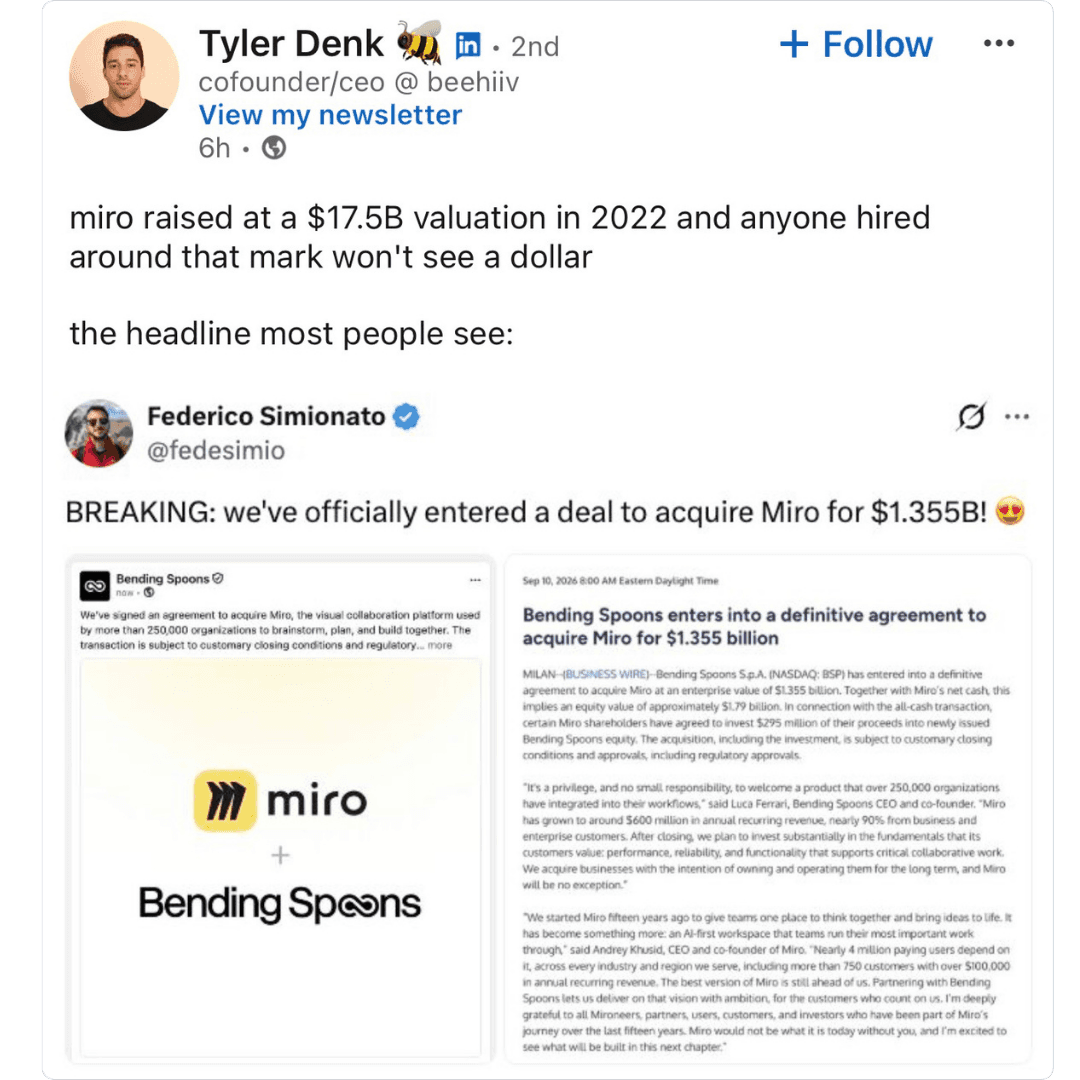
Denk is naming the reality employees learn too late. When a company sells for a fraction of its peak, the equity granted at that peak is often worth nothing, because investor liquidation preferences get paid back first and common shareholders are last in line. That is the exact dynamic we broke down in the Airtable post, and it applies with force here. The $1.355 billion headline is a real number for Bending Spoons and for Miro's early investors. For an engineer who joined in 2022 on a grant priced against $17.5 billion, it can round to zero.
Now start with the balance sheet. Bending Spoons carries roughly $4.36 billion in total debt, and its interest expense is climbing faster than its revenue. In 2025, interest consumed about 51% of operating income. By early 2026 that figure was closer to 78%. A debt-funded roll-up compounds beautifully while credit is cheap and every acquisition performs. It gets fragile fast if either of those turns.
There is also a limit to the zombie thesis itself. Not every company that sells below its peak is a zombie, and not every 2021 unicorn is doomed. Some are still growing fast and will grow into their marks. Miro itself is not a disaster. It sold for more than the $476 million it raised, and some of its shareholders rolled $295 million into Bending Spoons stock, a bet that the acquirer is the better horse. The honest read is that AI is repricing a large class of mid-tier software, hard, but the repricing is uneven, and calling every stalled unicorn a corpse is as lazy as calling every AI startup a winner. The skill is telling them apart.
What is Bending Spoons' next move?
Watch for bundling, because that is where a portfolio like this eventually points.
Once you own the customer relationships from Airtable, Miro, WeTransfer, and Evernote, the logical next step is to package them and sell the bundle into enterprise. Microsoft wrote that playbook. Slack was the better chat product, and Microsoft still beat it by bundling Teams into Office for free and pushing it to a base that was already paying. It worked so well that Slack filed an EU antitrust complaint, and in September 2025 Microsoft agreed to unbundle Teams to settle it. Bending Spoons is assembling exactly the kind of enterprise base that a bundle runs on. This has not happened yet, so treat it as the move to watch, not a certainty. But it is the natural endgame of buying this many products with this many shared customers.
Which companies could be next?
We flagged the playbook after Airtable, and Miro proved it again. So here is the profile of a target and the kind of company that fits it.
The profile is consistent. A well-known software brand, a large and sticky revenue base, growth that has stalled, a valuation well below its 2021 or 2022 peak, and a category now under pressure from AI-native tools. Bending Spoons has said it is hunting companies with $50 million to $500 million in revenue. That points at a specific pool.
Fits the profile | Peak valuation | Why it fits |
|---|---|---|
Zapier | ~$5B (2021) | ~$310M-ARR automation business sitting directly in the path of AI agents |
Calendly | ~$3B (2021) | Ubiquitous point solution, growth normalized, squarely in the AI-pressured cohort |
Dropbox (public) | Trades far below its history | Profitable, cash-generative, mature: the exact roll-up shape |
Box (public) | Named among 2026's most-cited take-private targets | Sticky enterprise base, steady cash flow, modest growth |
Asana (public) | Below its IPO price | Enterprise base, decelerating growth, founder ownership question |
One caveat matters, and it points at the ways this story does not end in a fire sale. Not every 2021 unicorn is prey, and the escapes are instructive. Some grew into their marks and walked out the front door: Notion filed to go public in early 2026 at a reported valuation near $18.5 billion, well above its old $10 billion private mark. Others escaped by becoming the acquirer. Grammarly spent the last year buying Superhuman, Coda, and Rows, rebranded the entire company as Superhuman, and repositioned around an AI productivity suite. 1Password bought its way into agentic-AI security and is now floating IPO talk of its own. That is the whole menu: grow into your valuation and go public, buy instead of get bought, or sit still on a boom-era mark while AI erodes the category around you. Only the third option ends at a roll-up.
Why does any of this matter to your clients?
Because your clients are holding equity priced for a world that AI just ended, and most of them do not know it.
More of your high-net-worth clients, and their kids, are joining or founding private tech companies with a large share of their net worth in equity. The old mental model said a category-leading product at a big valuation was a safe bet. Miro just proved a category-leading product can reprice by 90% and get sold for parts, because AI knocked its growth over. A client with concentrated equity in a stalled 2021-era company is exposed to a risk almost nobody is pricing: the paper valuation reflects the last boom, and the exit will reflect the AI reset.
You cannot see that risk at CNBC speed. You can see it in a client's cap table and their company's competitive position against AI-native rivals. The advisor who sits down and asks "is your company growing into its valuation, or is AI quietly turning it into a zombie?" is doing something the client cannot get anywhere else. That is the conversation that turns a tech employee into a lifelong client.
And it loops back to the theme running through this entire AI cycle: staying current is the job. The winners and the casualties are being sorted right now, and clients are watching the same headlines you are. Being the person who saw the other side of the AI boom before they did is how you stay a step ahead.
Three things to raise with a client who holds tech equity
Walk in with these and you are the most useful person in their week.
"Is your company growing into its valuation, or has AI stalled it? Miro was a category leader and still repriced by 90% when its growth fell to 5.6%. Let's look honestly at your company's growth against AI-native competitors."
Growth rate is the tell. A high valuation on stalling growth is a zombie waiting to be repriced. Name it early.
"Your equity was priced in the last boom. Let's stress-test your number against a realistic exit, not the last funding round."
The gap between a 2021 mark and a real 2026 exit is the whole planning conversation. Get ahead of it before a client bets a mortgage on a paper number.
"You may be long AI and short AI at the same time. Let's map which of your holdings AI is helping and which ones it's quietly eating."
Most clients only see the upside of the AI boom. Showing them both sides of their own portfolio is the insight they will remember you for.
Frequently asked questions
Why did Miro sell for so much less than its peak valuation?
Miro raised at a $17.5 billion valuation in January 2022, about 41.7 times revenue, at the top of the tech boom. To justify that price it needed to grow fast for years. Instead its growth collapsed from triple digits to 5.6% a year by 2024, as AI assistants and AI-native competitors pressured its category. A company priced for hypergrowth that stops growing gets repriced hard, and the market valued it at roughly 2.3 times its ~$600 million in recurring revenue, putting the sale near $1.355 billion. The product did not fail. Its valuation was built on growth that AI helped end.
What is a zombie unicorn?
A zombie unicorn is a startup that raised a huge valuation in the 2021 or 2022 boom, still generates real revenue, but has no realistic path back to that valuation. These companies are too large to be quietly acqui-hired, too slow-growing to IPO near their private marks, and past the era of cheap venture funding. Their most likely exit is a discount sale to an acquirer, often a roll-up. Miro, sold for about a tenth of its peak, is a clear example.
How is AI destroying software value, not just creating it?
AI is a two-sided wealth event. At the frontier it is creating historic value in companies like Anthropic and OpenAI. In the vast middle of incumbent software, it is destroying value by commoditizing features and enabling AI-native competitors to rebuild established products quickly. Miro's growth stalled exactly as AI tools moved into its category. The same force behind the AI equity boom is repricing the previous generation of software downward. Most coverage only tracks the value being created, not the value being erased.
How can an advisor help a client with concentrated tech equity?
Start with the company's growth rate and competitive position against AI-native rivals, not the last funding round. Ask whether the company is growing into its valuation or stalling. Compare the client's paper valuation to a realistic exit in today's repriced market, and map which of the client's holdings AI is likely to help versus quietly erode. That analysis turns a vague, boom-era number into a real financial plan.
This post is for informational purposes only and does not constitute investment, tax, or legal advice. Deal figures and analyst estimates are drawn from publicly available reporting as of the publication date and may change as the transaction closes. The list of potential acquisition candidates is illustrative pattern analysis, not a prediction or any form of inside information. Individual equity situations vary widely. Clients should work with qualified advisors on their specific circumstances.
Sources: Bending Spoons investor newsroom, Bloomberg, TechCrunch on Bending Spoons, Miro Series C / TechCrunch, Sacra on Miro, Mostly Metrics S-1 breakdown, CNBC on the Microsoft Teams unbundling.